We're All Trying to Find the Guy Who Won't Question Mark Carney
The Globe and Mail attempts media criticism... kind of


Missing news media criticism in Canada? Sign up to The Catch to receive principled scrutiny of legacy news every week!
It's increasingly impossible to ignore that Prime Minister Mark Carney is getting an easy ride from Canadian news media. Some of this is understandable. His numbers remain sky-high in nearly every single poll. His 2025 election win, and subsequent floor-crosser majority, left whatever official opposition he may have absolutely scrambling. Conservative leader Pierre Poilievre does his best, but struggles with headlines surrounding internal party chaos weaving between his calls for transparency and a more right-wing approach. Avi Lewis is good at garnering the occasional headline, but the NDP is laughably irrelevant.
Yet Carney has had plenty to criticize. His "Build Canada Strong" act has left Indigenous representatives reeling from the blatant trampling of their rights. The Toronto Star revealed that nearly 30 per cent of the "Buy Canadian" policy went to companies based outside of Canada, including the US and the UK. What has the response been from the Carney and the Liberals? Well Carney rejected the Pentagon's critiques of Canadian military policy.
Carney's budget, nationalist rhetoric and alliances abroad all provide ample room for critique. News media, in all its poetic waxing, touts itself as the pillar of society that provides that scrutiny. With all of these problems and a crisis moment in terms of an economy, holding the powerful to account should be par for the course. It isn't.
That's why it was a pleasant surprise to see an episode of The Globe and Mail's daily news podcast The Decibel titled "The questions we’re not asking Mark Carney." Host Sherrill Sutherland interviews Shannon Proudfoot, feature writer in the outlet's Ottawa Bureau, about an opinion piece she penned on the same subject. "It’s sort of amazing," Proudfoot writes. "The degree to which everyone has nodded along and deferred to the banker man on issues that, in a different moment, would surely have raised energetic discussion, if not hackles."
In the article, Proudfoot questions the blatant acceptance of the NATO target to spend five per cent of GDP on defence, his dodgy responses to the Gordie Howe International Bridge debacle and expansion of power around federal ministers. Then, she interviews experts. It's quite a good piece, frankly. Examining how Carney wields the shield of nationalism in desperate times, how Conservative critiques essentially amount to "Be more Conservative" and the hollow "principled pragmatism" in international relations. All coalesce into a compelling case for an environment that critiques Carney more than it acquiesces.
But there is one glaring omission: the media's role in propping up Carney's image must be examined, critiqued and rectified. Proudfoot's piece only implies the role that news media plays in one sentence, "Problems or missteps that would have sicced a week-long news cycle on other prime ministers have been mere hiccups for this one." The Decibel episode barely expounds on this, when Proudfoot says "I would even say the media in a way- there's a sort of a deference to Carney."
 Scott Martin
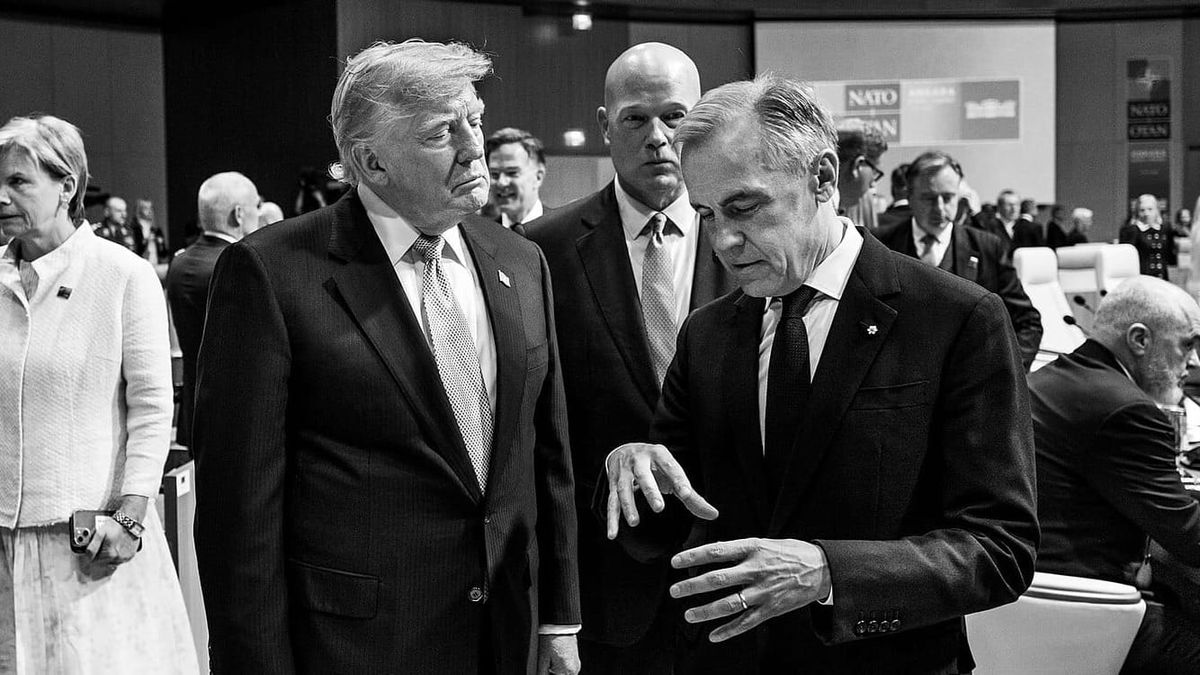
Quasi-criticism such as this is frustrating on many levels. For example, many of us have been criticizing Carney. Weak opposition in Parliament does not mean weak opposition in general. Proudfoot does, rightly, note that there has been pushback against Carney's environmental policy from advocacy groups, but ignores other movements, like those mobilizing against Canadian support of Israel. In another instance, World Against War Canada has been consistently organizing demonstrations against Carney's militarism. Carney's approach to transparency has been criticized by Poilievre in terms of economic deals, as well as experts in political ethics regarding closed-door fundraisers.
Proudfoot's aside that news media shows deference to Carney is instrumental in this lack of critique gaining a stronger foothold. The overwhelming coverage of Carney's vast boost in 2025 to the military was positive. The newly passed budget proudly declared "Over five years, starting in 2026-27, generational investments in defence will total more than $700 billion on a cash basis." This includes $125.5 billion for 2026-2027, up from $114.6 billion the year before. Despite this massive increase ($46 billion in 2024-2025), news coverage often focused more on the feasibility of meeting NATO targets, rather than the actual implications for Canadian society.
So, yes, the Canadian public has often let Carney get away with too much. However, to bring this phenomenon up without substantively delving into the news media that facilitates this easy ride is disingenuous. Carney's poll numbers are high, largely owing to the authoritativeness he displays in news coverage. That deference, only hinted towards by Proudfoot, is a huge reason why he continues his extended honeymoon. Yet by criticizing this tacit approval in general, the role of news media is almost entirely obscured.
Of course this applies to more than just Proudfoot, but the Globe and Mail claiming "we" aren't asking questions sounds suspiciously like the same "we" trying to find the guy who did this.