Neocolonialism: The Tyee's Solution to Geopolitics
A NATO by any other name is just as imperialist

It doesn't take an expert analyst or a seasoned political veteran to understand that the current world order is facing a massive reshaping. Pundit after pundit, in Canada and abroad, will point to US President Donald Trump's openly imperialist foreign policy, the ascension of China, and the 19th century warmaking of Putin's Russia as ironclad examples that the international "rules-based order" is over. A new era is here.
However, the nuances of this view vary. The "international rules-based order," has never applied to meaningfully applied to Great Powers. Israel's incursions into Palestine, the Soviet occupation of Afghanistan, the US invasion of Vietnam, Panama, Grenada, or Korea (or their long list of coordinated coups of sovereign nations) all lacked restraint from the international community. Since the overthrow of the Soviet Union, the US has assumed dominance. The country invaded Afghanistan and Iraq, bombed Libya and protected ally states from international repercussions, all with assistance from NATO or absent of UN restrictions.
This was starkly revealed in regards to International Criminal Court investigations against Israeli politicians. During the process, an anonymous senior official told ICC prosecutor Karim Khan, "This court was built for Africa and thugs like Putin."
Disproportional application of laws, and the force required to impose them, has always focused on the global south. But there was a moment, 70 years ago, that hoped to rectify this treatment.
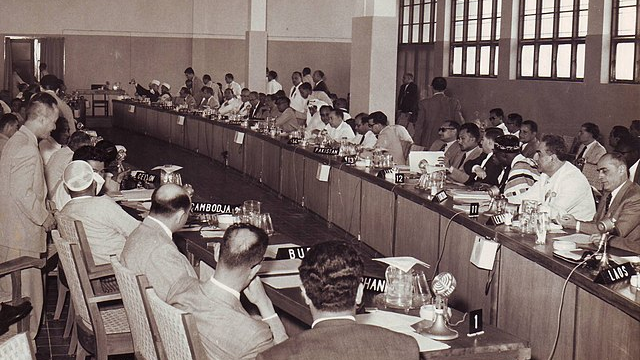
An often overlooked, but monumental, point of world history is the Bandung Conference, held in Indonesia, April of 1955. The Asian-African Conference (as it was officially known), gathered representatives from decolonized countries, even those who had yet to officially gain independence, to navigate the post-WWII international order. Officially, Bandung hosted the heads of government from twenty nine Asian and African countries. Indonesian President Sukarno gathered these states as they formed the essence of the "Non-Aligned Movement;" a decolonial coalition that would strive for independence from the US and the Soviet Union. Indeed, the origins of the term "Third World" were meant to be a proud label, striving for the independence that had been ripped from the people of colonized nations. On the final day of the conference, their ten principles were issued; These lofty goals focused on sovereignty of nations, mapped onto of the Charter of the United Nations.
Over the next decade, this coalition splintered. Interference by western nations, primarily the US, disrupted the Third World in immeasurable ways. The playbook for coups of uncooperative governments, cemented in the US-sponsored overthrow of Mossadegh in Iran 1953 and Arbenz in Guatemala 1954, both inspired the Bandung Conference's focus on sovereignty and ensured its destabilization. Canada, for its part, joined in as well. Canadian military officials provided crucial information that allowed rivals of Congolese Prime Minister Patrice Lumumba, a decolonial Marxist, to kidnap and murder him in 1961.
It would be erroneous to solely blame the interference of the American empire for the collapse of the Non-Aligned Movement. Much criticism has been levied against the leaders and participants for their errors. However, the role played by the legacy of colonialism, and the actions of the US and its allies, in the Bandung Conference can not be overstated. This was a gathering of nations that focused on sovereignty and independence in the face of world empire and the deeply entrenched horror of colonialism.
To omit this fact is to spit on the legacy of those who hoped to unite in defence of Third World sovereignty.
 Scott Martin
Enter The Tyee and its contributing editor Crawford Kilian. In what appears to be a pattern of behaviour supporting liberal imperialism, Kilian's headline reads "I’m Calling It. Time for a New NATO." His argument begins by lamenting the collapse of the "international rules-based order," in the form of the United Nations and the North Atlantic Treaty Organization (NATO). Kilian claims NATO "seemed in reasonably good health until Vladimir Putin launched his first attacks on Ukraine in 2014." He then lambasts the lack of military response to Russia's actions in that year. According to Kilian, the 1999 NATO bombing of Yugoslavia, the 2001 Article Five invocation in regards to Afghanistan and the 2011 bombing of Libya were all above the level and indicated good health.
Already we see a fracture in the logic, now that the US unilateral actions are far more blatant, with threats against other countries more pointed, now is apparently the moment things are no longer working. The 19th century, one where European colonialism was supercharged, is referred to as "global anarchy," by Kilian. Even when the kidnapping of Venezuelan President Nicolas Maduro is justified by explicitly pointing to the Monroe Doctrine, Kilian ignores colonialism as a factor.
In this new alliance, excluding the US, Russia and China, Kilian's new NATO includes "most of the NATO nations, those with fairly elected democratic governments." Who would decide which government is "fairly elected" and "democratic" would presumably be the global north. But Kilian has the tenacity to mention colonization for the first time, in the terms of the Bandung conference being called to avoid "being recolonized by either the West or the Soviets."
This kind of thinking requires truly staggering levels of cognitive dissonance. Though the participants at the time were not fully aware, as Kilian should be, the Soviet Union's larger legacy would become that of supporting and supplying decolonial movements (e.g. Vietnam, Angola and South Africa), while the US' legacy was re-entrenchment of colonial superstructures (e.g. Vietnam, Chile, Nicaragua). In the modern day, Kilian warns of China's threat to sovereignty by pointing to their actions in the South China Sea. China's relationship to the Third World is often misunderstood, but is far more positive than its critics allow. Some will point to the "Chinese Debt Trap" narrative, that China makes deals to force trade countries into submission, but that has been thoroughly debunked.
While the decolonial legacy of communist countries like the Soviet Union, China and even Yugoslavia is far more nuanced and complicated than the good and evil dichotomy, Kilian doesn't even consider it worth exploring.
Kilian also doesn't seem to grasp the eventual dissolution of the Bandung Conference. His argument suggests new nations could be added to this new NATO (an example Kilian gives, perplexingly, is an independent Siberia). While more nations were indeed added to the Bandung Conference, their impact was grossly diminished by the aforementioned coups and destabilization by the US. Destabiliziation that Canada was largely aligned with.
Central to this argument is the belief in expanded Canadian militarism, without any examination of Canada's role in perpetuating and benefiting from colonization, both on this land and across the world. Kilian refers once again to his belief that all of Canada should prepare "for anything from a collapse of the electrical grid to an outright invasion." This dovetails neatly into the federal government's demand for more soldiers, military equipment and militarism.
Kilian's proposal remains attached to the liberal internationalism that led to this catastrophic geopolitical moment. Instead of any reevaluation, his solution is reductive: kick the US out of NATO, learn no lessons from the Non-Aligned Movement and continue to pour money into militarist expansion.
In truth, this article has only scratched the surface of problems with Kilian's approach. It sidesteps the rise of the far-right in NATO countries, ignores the organization's historical purpose and prescribes this solution as the only alternative to the Trump, Putin, Xi trifecta. Ironically, the paragraph where he warns against this is where he accurately describes the fear he holds. If these figures and their countries aren't sidestepped, every other country (especially Canada) would "function as nothing more than sources of raw materials for their economies and militaries." In a word: they would become a colony.
It's shocking to read this type of analysis in a progressive outlet like The Tyee. But its stance on Canadian militarism has been made apparent in the past year. Canada has been an active, and willing, participant in perpetuating colonialism over the past century. So to co-opt the attempt of Third World nations to move past that paradigm and frontload the sovereignty and independence of colonial peoples, all in service of perpetuating the dominating global order, is blatant neocolonialism.
Solutions like Kilian's suggest the only paths forward are to either perpetuate the colonial order under a different banner, or become a colonial subject yourself. Not exactly the decolonial Third World that those in Bandung April 1955 had envisioned, is it?